Moosiqs
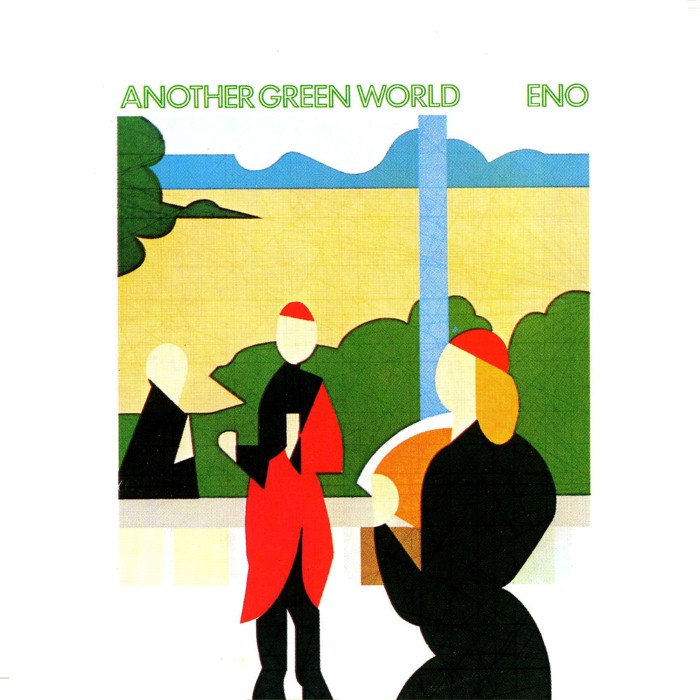
Another Green World
Brian Eno
Released: 1975
- Genre
- Experimental
- Style
- Electronic
- Format
- Album
Brian Eno’s first two solo albums, 1974’s <i>Here Come the Warm Jets</i> and <i>Taking Tiger Mountain By Strategy</i>, weren’t too far from what he had been playing in Roxy Music just a couple years prior: catchy, glam-infused art rock from which unexpected details (a nonsense phrase, an eerie swatch of backmasking) sprouted as colourfully as the feathers in Eno’s boa. But by the next year’s <i>Another Green World</i>, the properties of his universe had gotten stranger. Straight lines turned soft and bendy; a coppery tarnish crept across his music’s once-bright hues. The shift is right there in the opening “Sky Saw”, whose murky swirl suggests a kind of aquatic dub funk, and “Over Fire Island”, in which Percy Jones’ fretless bass bubbles like magma beneath Eno’s dolefully drizzling synth lead. <br /> Eno had toyed with improvisation and stream-of-consciousness lyrics previously, but <i>Another Green World</i> marked a step further into the unknown: It was written and recorded on the spot, and he used his <i>Oblique Strategies</i> cards—an aleatory, free-form brainstorming aid—to point him toward new sounds, methods and tone colours. His invention of ambient music was still a few years away, but you can hear him edging toward it in the contemplative rhythms of “In Dark Trees”—which anticipates the globe-trotting explorations of 1981’s <i>My Life in the Bush of Ghosts</i>, with David Byrne—and “Sombre Reptiles”, featuring a slinky sound Eno termed “snake guitar”. But for all his experimenting, he didn’t ignore his pop instincts: “St. Elmo’s Fire” is as immediate and indelible a tune as he’s ever written, right down to its vividly surrealistic lyrics.